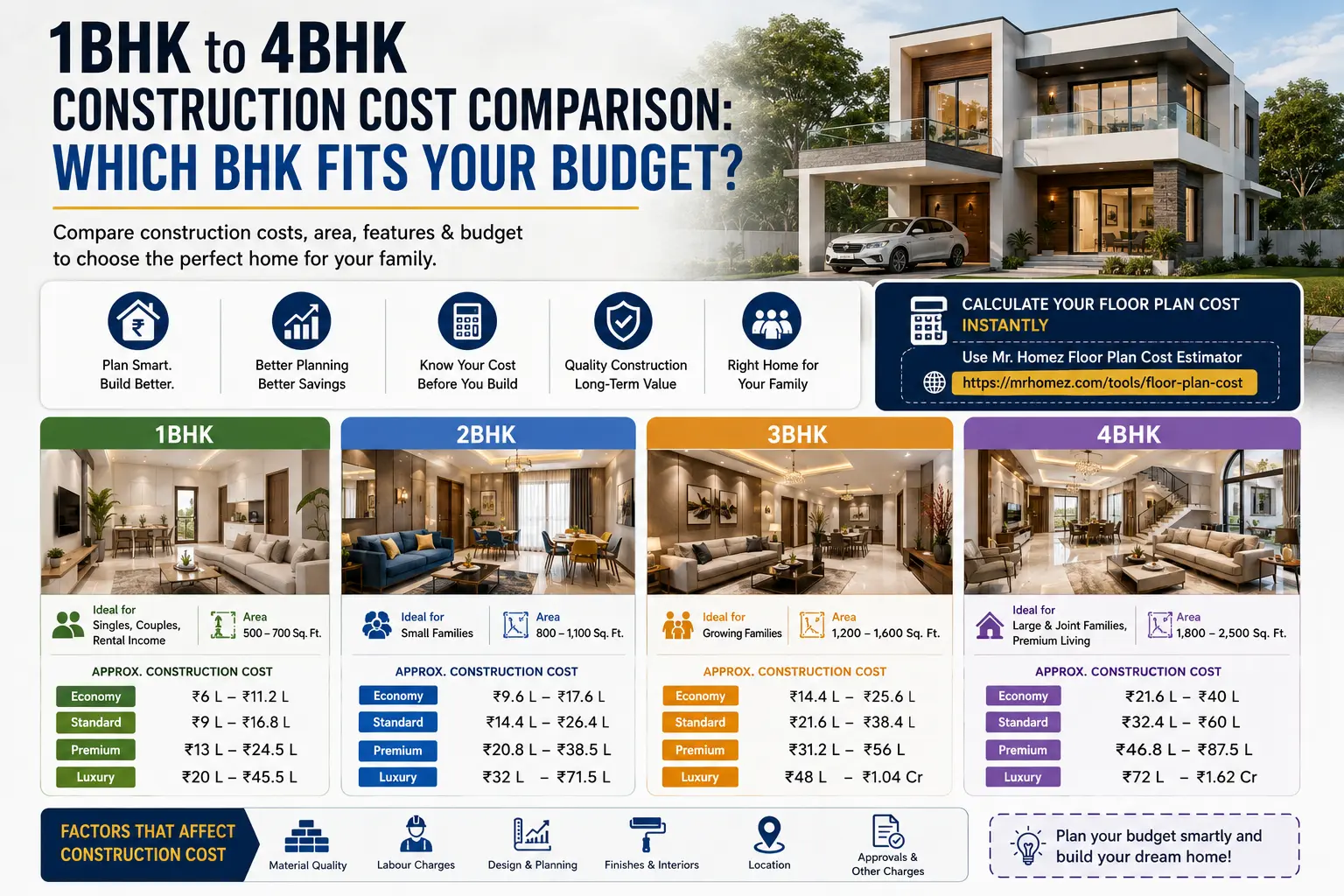
Building a home is exciting, but the financial side can become stressful very quickly if you do not have a realistic budget from the start. That is where a construction cost calculator becomes useful. Instead of guessing the total expense, you can begin with a practical estimate based on your built-up area, type of construction, finish level, and local market conditions. A good calculator gives homeowners a faster way to understand the likely house construction cost before they commit to design, labour, and material decisions.
If you are planning to build a house, one of the first questions you will ask is simple: how much will it really cost? The answer depends on several factors, including the size of the house, quality of materials, labour rates, city or region, number of floors, and finishing choices. Industry calculators and guides in India consistently note that costs vary by location and material quality, and are commonly estimated on a per-square-foot basis.
Mr. Homez already offers tools focused on property and budget planning, including its Construction Cost tool, Floor Plan Cost tool, and other property calculators. That makes this topic a strong fit for users who want quick answers before moving deeper into home planning.
Why a construction cost calculator matters before starting your project
Many people begin construction with only a rough idea of total cost. Later, they realize that the actual budget includes much more than cement and bricks. A realistic home building budget should account for structure, labour, electrical work, plumbing, flooring, paint, fixtures, and a buffer for market fluctuations. A home construction cost calculator helps turn a vague plan into a starting estimate that feels easier to manage.
It is also useful for comparing choices. For example, if you are deciding between a basic finish and a premium finish, or between a single-floor home and a duplex layout, the calculator helps you see how each choice affects the total cost to build a house. This gives users more confidence before they speak with a contractor, architect, or builder.
What affects house construction cost?
The total house construction cost is never based on one single factor. It is shaped by a combination of decisions and market conditions.
Built-up area
The most basic input is the size of the home. In most cases, construction cost is calculated by multiplying the built-up area by the estimated construction cost per sq ft. This makes square-foot pricing one of the most common ways to plan a residential budget.
Location
Construction rates are not the same in every city. Material transportation, labour availability, local demand, and regional pricing all change the final estimate. Tools from Indian construction brands also use location as a major input because the same home can cost differently across cities and states.
Quality of materials
Your total budget changes significantly depending on whether you choose standard materials or premium products. Cement, steel, bricks, tiles, sanitary fittings, windows, doors, and paint all influence the total. Even small upgrades, when applied across an entire home, can raise the final cost noticeably.
Labour and contractor charges
Labour is a major part of any residential build. Mason work, shuttering, plumbing, electrical installation, plaster, flooring, carpentry, and finishing all add to the final amount. A proper building cost estimator should help users understand that labour is not a minor add-on. It is one of the main parts of the budget.
Structure and finishing level
A bare structure and a move-in-ready home are two very different cost scenarios. Civil work may form the base estimate, but the total rises once you add floor finishes, modular kitchen work, wardrobes, painting, lighting, fittings, and exterior details.
Average construction cost per sq ft in India
For users searching online, one of the most common questions is the average construction cost per sq ft. Published industry estimates show that standard home construction in India often falls in a broad range, and premium finishes can push it higher depending on materials and design. One recent source cites average standard construction costs around ₹1,700 to ₹2,500 per sq ft, while another 2026 guide breaks some components down further by work category.
That is exactly why a construction cost calculator is valuable. It gives a working estimate, but users should still treat it as a planning number, not a final contractor quote. Actual project cost can shift because of site conditions, design changes, local labour availability, and brand choices for materials and finishes.
How a home construction cost calculator helps users
A good home construction cost calculator makes planning easier in a way that feels practical, not technical. It usually works by taking a few core inputs such as area, house type, finish quality, and location, then returning an estimated total cost. Some calculators also help users understand material and labour impact or phase-wise spending.
For homeowners, this has several benefits. It helps them set realistic expectations before starting construction. It improves financial planning. It reduces the chance of underestimating costs. It also helps when comparing different home sizes or specifications. Most importantly, it gives users a better starting point for conversations with contractors and architects.
How to use a construction cost calculator effectively
To get a more useful result from a construction cost calculator, users should avoid entering random numbers just to get a quick total. The more realistic the inputs, the more useful the estimate becomes.
Start with the correct built-up area rather than an approximate guess. Think about the type of finish you want, because basic, standard, and premium homes do not share the same pricing. If the tool asks for location or pin code, use it carefully because costs vary by city. Indian calculator pages from cement and construction brands also highlight these kinds of inputs to improve estimate quality.
After you get the estimate, do not treat it as your final contract value. Use it as a planning benchmark. Then keep extra room in your budget for design changes, finishing upgrades, approval costs, and unexpected expenses.
Common mistakes people make while planning home construction budget
One common mistake is focusing only on structure cost and ignoring finishing expenses. Another is assuming the same square-foot rate applies to every city and every plot condition. Some users also forget site-specific factors such as soil condition, elevation, parking requirements, and additional floor loads.
A realistic home building budget should also include a contingency amount. Even a well-planned project can change because material prices move, labour schedules shift, or homeowners decide to upgrade part of the design after work begins.
What should be included in a home building budget?
A useful house construction cost estimate should reflect more than basic masonry. Users usually need to think about:
Civil work such as foundation, columns, beams, slabs, brickwork, plaster, and roof work.
Material cost including cement, steel, bricks, sand, aggregate, and blocks.
Labour cost for masons, helpers, carpenters, electricians, plumbers, tile workers, painters, and fabricators.
Finishing cost such as flooring, wall paint, false ceiling, bathroom fittings, kitchen fittings, and doors.
Services and approvals including design fees, plan approvals, utility charges, and site preparation where applicable.
When users understand these layers, they stop thinking of a calculator as a single-number tool and start seeing it as a smarter way to prepare for actual home building.
Why this topic works as a cluster blog for Mr. Homez
This blog fits naturally into a broader property-planning content cluster. Mr. Homez already has calculator-based content and tools around property value, floor plan cost, area trends, stamp duty, and construction-related planning. That means this blog can support internal linking and improve topical relevance around real estate budgeting and home decision-making.
This also helps users move from one planning stage to another. Someone estimating construction cost per sq ft may next want to compare floor planning, area trends, property value, or ownership charges. That kind of journey is useful for both SEO and user engagement.
Final thoughts
A construction cost calculator is one of the simplest tools for turning a home idea into a workable budget. It helps users estimate cost early, compare options, and avoid unrealistic assumptions. While no calculator can replace a final site-specific quote, it gives a valuable starting point for smarter planning.
If you are preparing to build your dream home, using a home construction cost calculator early can save time, reduce confusion, and support better financial decisions. It is not just about seeing one number on a screen. It is about understanding the full picture behind your home building budget and planning your next step with confidence.