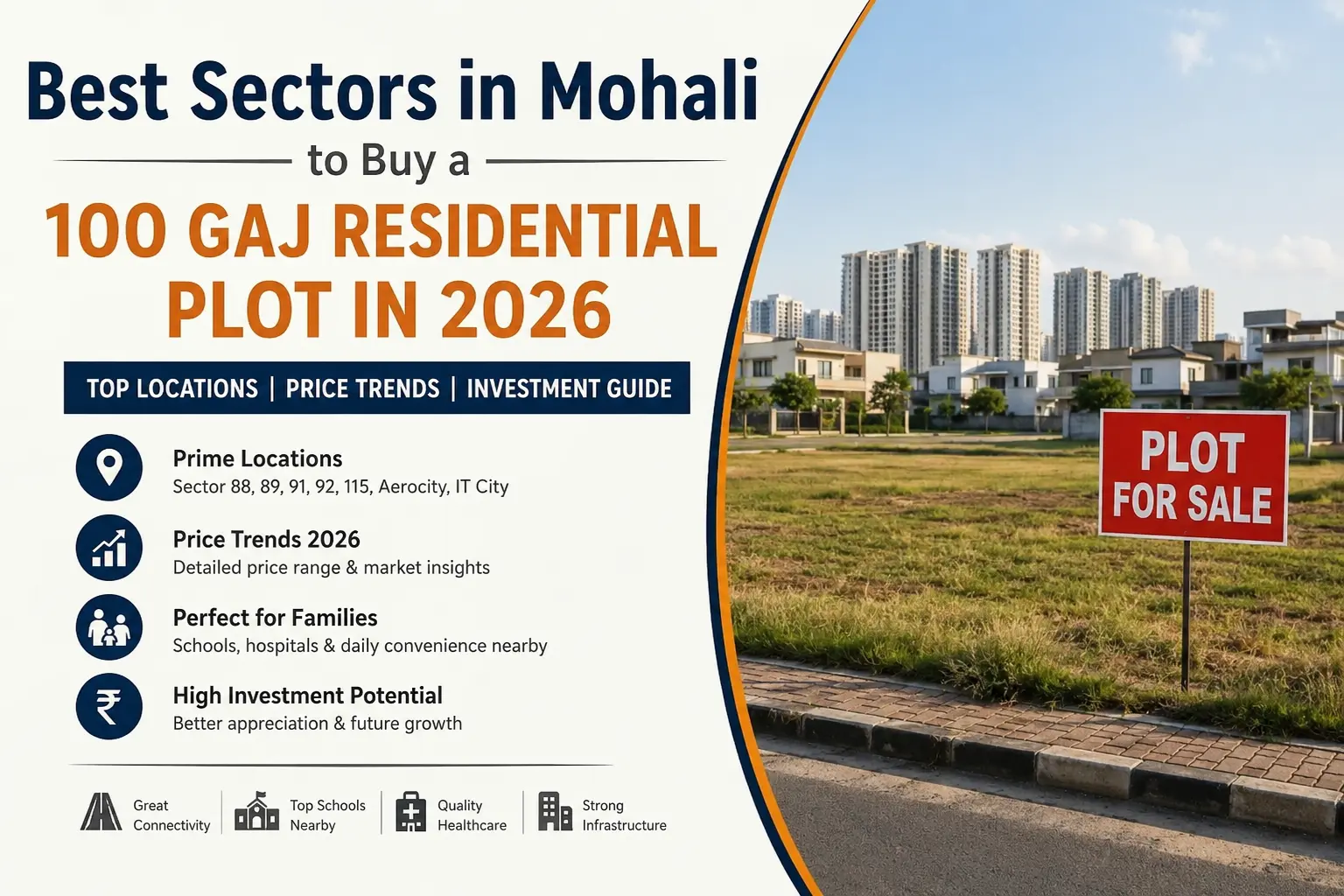
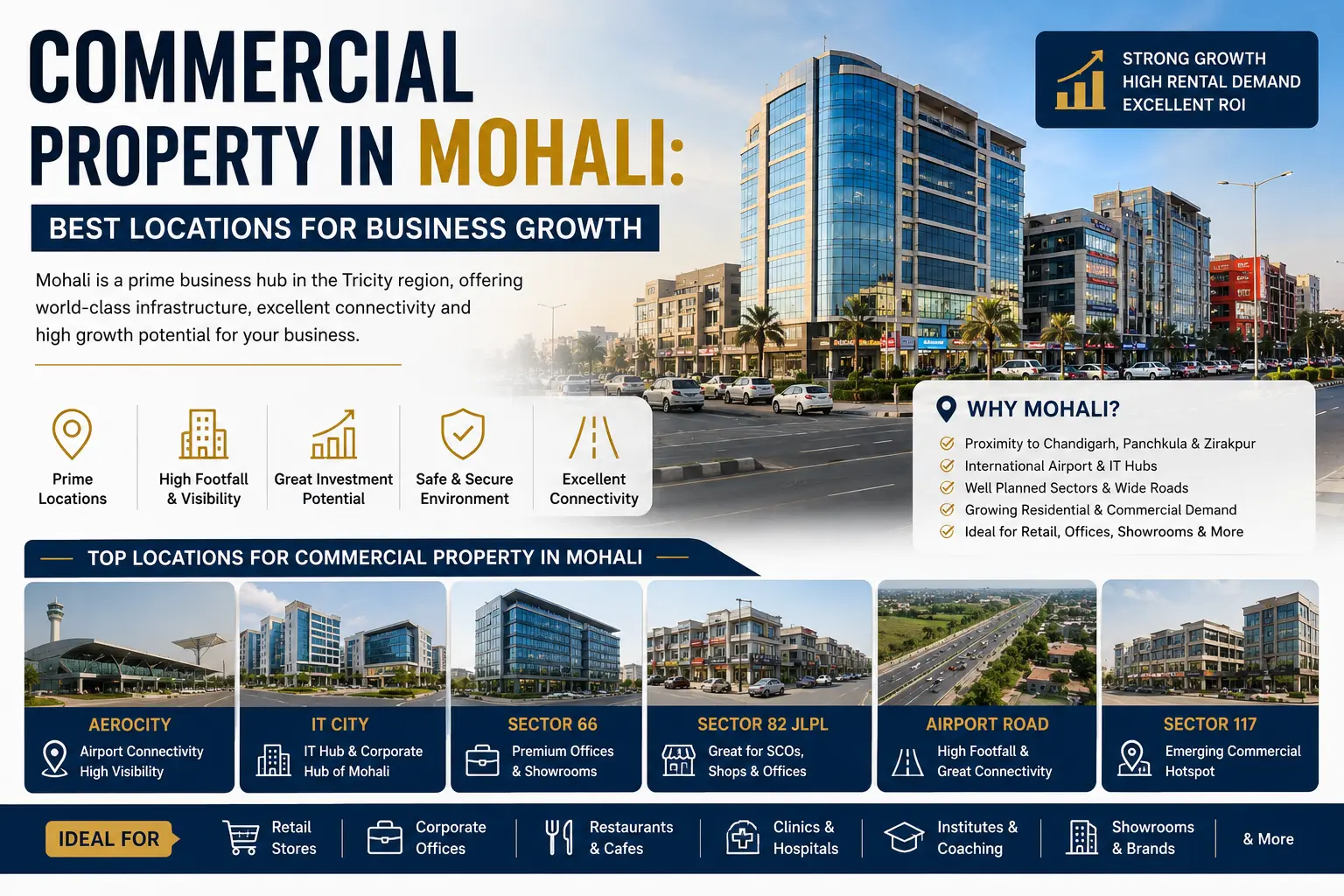
A beginner’s guide to how Mohali, Zirakpur, and Kharar changed, and what those price moves really mean
If you are trying to understand property price trends in Chandigarh region, start with one simple idea: this market no longer moves as one block. Chandigarh itself remains premium, while buyers and investors increasingly spread into Mohali, Zirakpur, and Kharar. As a result, the region has seen both price growth and price reshuffling between 2020 and 2026. The broad Tricity benchmark also shows the market moving upward. NHB data, surfaced through CEIC, put Chandigarh Tricity’s under-construction market price for 646–1184 sq ft homes at ₹7,708 per sq ft in September 2024, the highest point shown in that series up to that date. Current portal averages in 2026 also show Mohali above Zirakpur and Kharar on average, although each market behaves differently inside its own micro-locations.
For a beginner, that difference matters. Mohali usually attracts buyers looking for stronger long-term positioning, better planned sectors, and premium corridors. Zirakpur pulls in end-users who want better affordability with urban access. Kharar often appeals to budget-conscious buyers who still want room for upside. So, instead of asking which city is “best,” it is smarter to ask what kind of buyer you are and how much price movement your budget can absorb.
1. The Big Picture
Why the Chandigarh region moved up after 2020
The years after 2020 changed buyer behavior across the region. First, homebuyers started valuing space, road connectivity, and newer residential projects more seriously. Then, as core Chandigarh stayed expensive, nearby growth belts became more attractive. Mohali benefited from stronger planning and premium expansion corridors. Zirakpur stayed busy because it offered comparatively more affordable apartment stock. Kharar gained traction because it gave buyers lower entry points and, in many pockets, faster percentage appreciation from a smaller base. That is why the 2020–2026 story is not just about rising rates. It is also about where demand shifted.
Infrastructure also supported this shift. GMADA’s jurisdiction covers Mohali, Zirakpur, and Kharar, and its ongoing projects list includes Aerocity development plus the 200-foot PR-9 road linking the Aerocity/Airport Road side toward Kharar Banur Road. Invest Punjab’s Mohali materials also highlight the airport-linked growth story and Mohali’s expanding economic role, while Punjab’s IT/ITES sector profile points to IT City and the city’s role as a growing technology destination. In other words, demand did not rise in isolation. It rose alongside jobs, roads, and new urban expansion.
Policy signals matter too. In late 2025, Mohali’s collector rates were revised upward by roughly 20% to 32%, and Chandigarh also moved toward higher collector rates from April 2026. While collector rates are not the same as resale market prices, they usually reinforce the sense that the market has moved into a higher pricing zone.
2. Mohali
Premium growth, stronger planning, and higher entry prices
Among the three markets in this guide, Mohali usually looks the most layered. It has old established sectors, mid-market expansion belts, and premium airport-side corridors. Housing.com’s 2026 overview places Mohali’s average listed residential price at about ₹8,349 per sq ft. Meanwhile, 99acres shows developed Mohali zones such as Airport Road at around ₹8,500 per sq ft on average, while Aerocity flats sit roughly in the ₹6,200 to ₹9,000 per sq ft range. That tells beginners something important right away: Mohali is not one uniform market. It has both mid-range and premium pockets, and your exact sector matters a lot.
Now look at appreciation. Selected Mohali pockets have moved sharply over five years. Aerocity, for example, shows a 121.4% five-year move on 99acres, while Sector 79 land shows a 179.2% five-year change and Sector 77 land shows a 187.2% five-year change. These are micro-market numbers, not a clean citywide average. Still, they clearly show why many buyers view Mohali as a market with strong premium upside when the location is right.
For beginners, Mohali works best when you want a balance of end-user livability and long-term positioning. However, it also asks for a larger budget. If you buy here without understanding the sector, you can easily compare a mainstream area with a premium corridor and think the entire city is overpriced. In reality, Mohali rewards precise shortlisting. Airport-side and new-growth sectors behave very differently from older or more mixed-stock zones.
3. Zirakpur
The practical market that stays active because it stays accessible
Zirakpur remains one of the most searched and talked-about markets in the Chandigarh region because it sits in a useful middle zone. It gives buyers access to Tricity life without Mohali’s higher premium in many cases. Housing.com places Zirakpur’s average listed residential price around ₹6,246 per sq ft in 2026, while 99acres shows flats broadly in the ₹5,100 to ₹7,750 per sq ft range. That keeps Zirakpur relevant for families, first-time apartment buyers, and investors who want a market with frequent movement and broad ticket sizes.
The growth story is also strong, although it looks steadier than Kharar’s sharper percentage jumps. 99acres reports that Zirakpur, Mohali moved about 0.8% in one year, 26.3% in three years, and 64.4% in five years. Another Zirakpur overview on 99acres places the five-year change at about 71.8%, which supports the same larger story: this market has appreciated meaningfully, but it still remains more approachable than Mohali’s premium sectors.
That mix explains Zirakpur’s appeal. It is not always the market with the biggest prestige factor, yet it often wins on practicality. Buyers get apartment supply, reasonable entry compared with premium Mohali corridors, and strong repeat demand from people who want location value without fully stretching the budget. So, if you are new to real estate and want a simpler first comparison point, Zirakpur often feels easier to understand than Mohali.
4. Kharar
Lower entry price, stronger percentage upside, and a value-first story
Kharar tells a different story. It attracts buyers who want a lower entry point and are willing to trade some polish for affordability and upside. On Housing.com, Kharar’s 2026 average listed residential price is around ₹6,270 per sq ft, but 99acres overview data place Kharar closer to ₹4,950 per sq ft on average, with flat ranges around ₹3,750 to ₹5,650 per sq ft. That gap itself is a reminder that Kharar is highly mixed. The stock type, project quality, and exact pocket can change the number quickly.
What really stands out is appreciation from a lower base. 99acres reports that land rates in Kharar moved 18% in one year, 56.7% in three years, and 169.2% in five years. Kharar Landran Road shows another aggressive benchmark, with property prices up 15.9% in one year and 112.5% in five years on one overview page, while the detailed rates page shows land rate growth as high as 229.7% over five years in that corridor. This does not mean every property in Kharar is a winner. It does mean that the market has produced powerful percentage returns where demand and connectivity lined up.
For a beginner, Kharar makes sense when budget comes first. It can be a strong entry market for buyers who want to get into the Chandigarh region without jumping straight into Mohali pricing. However, you have to be more careful here. Builder reputation, road quality, resale liquidity, and neighborhood maturity matter more because the market is more uneven. So, Kharar can reward smart buying, but it can also punish rushed buying.
5. What the Graphs Actually Say
Read the trend, not just the number
The first graph compares approximate 2026 asking prices across Mohali, Zirakpur, and Kharar. Mohali sits highest on average, which matches its stronger premium positioning. Zirakpur and Kharar appear closer on some portal averages, yet their market character is different. Zirakpur feels more stable and apartment-led. Kharar feels more price-sensitive and upside-led.
The second graph is even more useful for beginners because it shows five-year appreciation benchmarks. Mohali’s premium corridors, especially Aerocity and sectors near Airport Road, have seen very strong moves. Zirakpur has grown solidly, but in a more balanced way. Kharar, meanwhile, has posted some of the sharpest percentage changes, mainly because it started from a lower base. That is why a smaller-ticket market can sometimes look more explosive on a percentage chart.
This is also where many first-time buyers get confused. A market can show a high percentage rise and still remain more affordable than a premium market. So, do not read appreciation alone. Read appreciation together with base price, product quality, and future usability. That gives you a much better picture of actual value.
6. Which Market Fits Which Buyer?
A simple beginner-friendly way to shortlist
Choose Mohali if you want stronger long-term positioning, more premium sectors, and better alignment with airport-side growth, formal planning, and employment-led expansion. It is the market that usually feels more future-ready, but it asks for more capital.
Choose Zirakpur if you want a more balanced first buy. It works well for many end-users because the entry level still feels more practical, while the market remains active and connected. In simple words, Zirakpur is often the “middle path” market in this region.
Choose Kharar if your top goal is affordability and you are comfortable doing more homework. It can work well for buyers who want to enter the market early, especially in improving corridors. Still, quality checks matter far more here.
7. Final Takeaway
The 2020–2026 trend is real, but local selection matters more than ever
The biggest lesson from these Chandigarh real estate trends 2026 is simple: prices have moved up across the region, but not in the same way. Mohali has pushed ahead as the more premium and planning-led market. Zirakpur has stayed relevant through accessibility and everyday demand. Kharar has delivered strong percentage upside because it started lower and kept attracting value-focused buyers. The market has clearly matured from the 2020 period into a more segmented 2026 landscape.
So, if you are a first-time buyer or investor, do not ask only, “Where are prices rising?” Ask, “Where does my budget fit, what kind of property do I want, and how long can I hold?” That is the real beginner’s framework. And if you are comparing Mohali property prices, Zirakpur property rates, and Kharar property prices side by side, that is exactly where a platform like MrHomez becomes useful.